 Jessica Tang
 An empty field still rests where the Maskwa House of Learning should be, a proposed student life building for Indigenous students at the University of Alberta that was initially announced over three years ago.
The $30-million, two-floor facility is supposed to sit just north of the Education Building and serve as a new hub for Indigenous students. The announcement of Maskwa House was made in November 2015 at U of A president David Turpin’s installment ceremony. However, the project has been in the works for over a decade and initially started in the late 90s under a different name, “Gathering Place.” Not much is known about the project before 2009, when there were several rounds of consultation on the project involving members from the university and local First Nation groups.
Maskwa House is meant to be a specialized space for Indigenous students on campus, used for programming and ceremonies. However, a quick Google search yields no results beyond 2016 as no developments have occurred on the project since building plans were approved at the committee level in September of that year.
Students like Nathan Sunday, a third-year native studies student who represents the faculty on Students’ Council, want answers from the university. Specifically, Sunday wonders what stage the project is in now and if it’s still on the university’s list of priorities.
“The university isn’t necessarily as transparent as I think a lot of us would like it to be,” he said. “Even just looking up the business plans for Maskwa House, or any information on it, you can’t find any. So how are students to know? That transparency isn’t there.”
So what are the university’s plans for the project? And why hasn’t Maskwa House been built yet? Is it a lack of will on the university’s behalf? Or is it a lack of government funding that’s holding the project back?
Chris Andersen, dean of the faculty of Native Studies, said Maskwa House would be a “one-stop shop” for Indigenous students. Being aware of the project since 1999, Andersen added that the building would allow First Peoples’ House, which runs programming and services for Indigenous students, to do other things they weren’t able to do before.
“One of the things it would add is kind of this spectacular, symbolic space to do the kinds of things that they’re already doing, and plus a bunch of other things they don’t have the capacity to do now,” he said.
If Maskwa House is built, the plan is for a number of Indigenous student services that are spread across campus to be moved into that facility. This would include First Peoples’ House — which has offices on the second floor of the Students’ Union Building — as well as Aboriginal Student Council, which is currently located in the North Power Plant close to Dewey’s.
One of the services focused on during the planning of Maskwa House was the Transition Year Program (TYP), which is currently run by First Peoples’ House. TYP helps first-year Indigenous students adapt to the changes that come with studying at a post-secondary institution. It provides not only academic support, but cultural supports as well through the provision of Elders and cultural teachers.
Ben Louie, the university’s architect, has worked on designing and planning Maskwa House since he joined the university in 2009. He said Maskwa House would provide a new base of operations for TYP.
“[Maskwa House] has an area on level one that really supports the transitional program,” he said. “Because the TYP program has been very successful, it actually needs a lot more space to make it functional.”
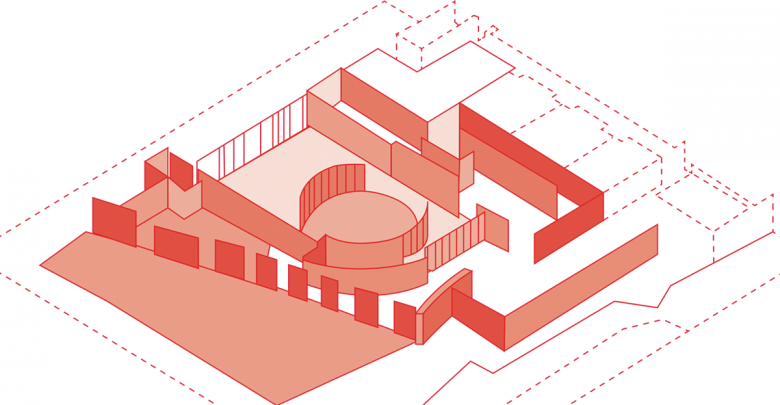
Some of the building’s other features include a kitchen space, change rooms and outdoor space for ceremonies, an Elder’s room, and multi-function rooms.
Louie also said the location of Maskwa House, just north of the Education Building underneath its trademark mural, would put the new facility in a place that gets a lot of traffic. He said that by choosing that location, Maskwa House would be a highly visible addition to campus.
“Location is everything,” he said. “Not only is it centrally located, it’s part of the circulation path, so it will make the building really accessible.”
The U of A wouldn’t be the first Canadian campus to have a specific facility for Aboriginal students to call home. The University of Saskatchewan has the Gordon Oakes Red Bear Student Centre, which opened in late 2015, and the University of Manitoba has the Migizii Agamik, or the Bald Eagle Lodge, which opened in 2008. Both of these buildings house various services for Métis, First Nations, and Inuit students.
Another example of a university facility for supporting Indigenous students is the First Peoples House at the University of Victoria, which was planned and built while Turpin was president of UVic from 2000 to 2013. According to the university’s website, First Peoples House opened in January 2010 and was built to serve as a “home away from home” for Indigenous students.
According to Andersen, many of these buildings were built not only in response to a growing movement for reconciliation, but to rising Indigenous enrollment in post-secondary institutions across the country. This includes the U of A, which saw the number of Indigenous undergraduates rise from 799 in 2009 to 1,081 in 2018. UVic also saw a 700 per cent rise in Indigenous student enrollment between 1999 and 2010.
According to the UVic website, planning for First Peoples House began as early as 2001 when Turpin “consulted with Coast and Straits Salish Chiefs and Saanich Elders about how to ‘create a welcoming and inviting environment’ for Indigenous students at UVic.” That project ended up costing $7 million, with the BC government paying $2.6 million.
The Gateway reached out to Turpin for an interview, however the university declined to add further comment, citing the ongoing nature of the Maskwa House project. But Andersen said Turpin’s hand in the creation of First Peoples House at UVic, as well as the mention of Maskwa House at his installment as president of the U of A, shows that the university is committed to the project.
“Turpin believes very strongly in the importance of making the university a safer and welcoming place for Indigenous students,” Andersen said. “This is something Turpin has a long relationship with and reputation for, which is valuing and prioritizing Indigenous students.”
So why hasn’t Maskwa House been built yet?
“I’ve been told that the reason why it’s taking so long is that the university says there are no donors for the project,” Sunday said. “I don’t know if that’s true or not or how much work the university has done trying to get donations.”
This sentiment is echoed by Katherine Belcourt, a third-year science student and president of Aboriginal Student Council, who feels that funding priorities tend to go to other faculties like engineering.
“I think it hasn’t been made a priority. I think that it should be a priority and it’s just something that’s easy to fall between the cracks,” she said. “There are a lot of things on campus that are prioritized over other things.”
While some might question the university’s commitment to the project, Andersen said that isn’t the case.
“I will say for a general level, this is not something that’s fallen off anybody’s plate,” he said. “This is something that’s still an institutional priority.”
The hurdle Maskwa House is facing isn’t coming from a shortage in willpower, Andersen added, but from the lack of government funding to support the project. He explained that most capital projects at the U of A are built with a combination of money from donors and funding from both the provincial and federal governments. He said the university has done feasibility studies with donors gauging their support for the project, which he said is high. Now, the only outstanding factor is funding from both levels of government.
While funding has not been secured for the project, Andersen said getting Maskwa House built is still on the university’s agenda. The university’s 2016-2021 institutional strategic plan, which outlines the goals of the U of A, states the development of a “thoughtful, respectful, meaningful, and sustainable response to the report of the Truth and Reconciliation Commission of Canada” as its fourth objective. The second of three strategies to fulfill that objective is the creation of Maskwa House.
Louie, the university architect, echoed Andersen’s conviction that Maskwa House will get built, saying it’s a question of “when” and not “if.”
“If it’s not important, why would it be objective four, strategy two of the Institutional Strategic Plan?” he said. “Of course it’s important.”
Louie added that since he has worked on the project, the university has taken steps to make it more practical. Originally estimated to cost $40 million in 2009, revisions to the project, such as connecting it to Education North instead of having it as a stand-alone building, helped bring the project costs down to $30 million in 2015.
As for the funding, Andersen said discussions between the university and both provincial and federal governments are ongoing, and that Turpin has brought the project up during several visits to Ottawa. However, for various reasons, the funding just hasn’t been made available.
“If you were to talk to people who were involved in the building of these [spaces] in other universities, it’s never a short process,” he said. “You kind of hope for a window of opportunity. Sometimes it looks like it might rise up and then doesn’t, but basically, it’s just sticking to it and hoping you get lucky and that the stars align at some point.”
While Andersen assures it’s still a priority, Sunday is doubtful if the project will get off the ground within the next five years.
“In my mind I’m skeptical,” Sunday said. “I would like it to be finished soon. However, just because we know it’s been on the university’s radar for so long, even before Turpin, I’m not sure that it will get done anytime soon.”